

How Hard To Get Into Cosmos
Ane of the hottest projects and coins in early 2019 was Cosmos and its Atom token. The initial surge began in 2019 when the mainnet that had been over iii years in planning went live.
Cosmos is an exceptionally ambitious project in a realm of aggressive projects. Information technology'south looking to become the blockchain that pulls all the other blockchains together in its blockchain interoperability platform. And every bit of February 2020 it looks like it could be succeeding.
However, tin they really execute on such chiliad ambitions?
Given the recent launch of the Inter-Blockchain Advice Protocol on Cosmos I'd say they can. Information technology took five years of research and development, but with the March 29, 2021 launch of the IBC dissimilar networks are now able to use Cosmos to exchange tokens and information seamlessly.
In this Cosmos Review I will take an in-depth wait into the projection, it'south technology and development roadmap. I will too analyse the utilise cases and adoption potential for the ATOM coin.
Creation Nuts
Creation calls itself the most customizable, scalable, powerful and interoperable ecosystem of connected blockchains. It's a decentralized network of independent blockchains powered by Tendermint and other Byzantine Fault Tolerant algorithms. It is Byzantine Error Tolerance that allows a blockchain to reach consensus even in an surround that potentially contains malicious nodes.
The Cosmos Network has the potential to become the "Internet of Blockchains", and is besides called the Cosmos Hub. Creation is the first blockchain to be launched on the Cosmos Network and its task is to link other blockchains (called zones in the network). Once these links are complete tokens can be quickly and securely transferred from one zone to some other seamlessly.

How Cosmos Solves Blockchain Issues
There are three master parts to the Cosmos Network:
- The Tendermint Core – The Tendermint Core is a software implementation containing the Tendermint BFT algorithm for consensus and the interblockchain communication (IBC) protocol which connects the consensus and networking layers to facilitate communication between the hub and all the zones.
- Application Blockchain Interface (ABCI) – This allows for the replication of dApps in a diversity of programming languages. Because ABCI is non constrained to any unmarried programming language developers are able to create the awarding portion of their blockchain in any linguistic communication. The ABCI acts every bit the connection between Tendermint Cadre and the Creation SDK.
- Cosmos SDK – This is the application layer of the Cosmos Network and provides developers with a basic blockchain framework. It reduces complexity by providing the near common blockchain functionality such every bit governance, tokens, and staking. Developers then add additional desired features by creating plugins.
Taken all together, the Tendermint Core provides consensus on the Cosmos Hub, while zone blockchains maintain their ain consensus without needing to employ Tendermint.
The Cosmos SDK provides developers with the means to build a blockchain and dApps while only worrying about the awarding layer. With the addition of ABCI awarding state is managed in a split consensus process, allowing Cosmos to support a wide multifariousness of scripting languages and cryptocurrencies.
Blockchains continued to the Cosmos Hub will be able to communicate with each other using the IBC Protocol, without regard for what consensus algorithm is used. This will allow the transfer of avails betwixt blockchains while preserving whatever contractual features they may have.
IBC will work best with blockchains that have high finality such as Proof-of-Pale blockchains, but can also be fabricated to work with Proof-of-Work blockchains through the employ of peg zones. An example of this is Ethermint, which is basically a Tendermint-based Ethereum with its PoW features stripped out and working on top of PoS consensus.
Explaining the Tendermint Algorithm
Tendermint is the starting time Proof-of-Pale consensus algorithm created using the Practical Byzantine Fault Tolerant (PBFT) algorithm first proposed in 1999 by Castro and Liskov after 30 years of enquiry. This BFT based PoS protocol assigns the right to advise new blocks in a pseudo-random fashion to validators in a multi-round voting process.
Finalizing and committing those blocks requires a supermajority of validators signing off on the proposed block, however. In the case of Cosmos, this is two-thirds of the quorum. Reaching consensus in this mode may take several rounds to finalize blocks. A BFT system can merely tolerate up to 1-third failures, with failures including malicious and arbitrary behaviors.
The Tendermint algorithm has the following features:
- A safety threshold of 1/three of validators
- Compatible with public or private chains
- Consensus safety
- Prioritization of consistency
- Instant certitude in under 3 seconds
Cosmos uses a Proof-of-Stake consensus known every bit delegated PoS. This organizes the stakers into groups of validators and groups of delegators. The delegators make up one's mind which validators will participate in consensus and the validators work to validate transactions and add together new blocks to the blockchain.
Rewards are given to validators and delegators in the form of Cantlet tokens, simply the Creation Network is designed in such a way that a wrapped form of any cryptocurrency could theoretically be used every bit a reward token. In this organization any nod constitute to be operating in a malicious fashion is removed from the network and its tokens are taken abroad.
What makes Cosmos Superior?
Cosmos is working to solve both scalability and usability limitations in blockchain technology. Scalability has been the greatest outcome amongst the globe's largest blockchains over the past few years, and none have been able to implement a solution yet that allows them to go anywhere nigh the scale they will need to arrange mainstream adoption rates.
When usability is considered, both developers and users are limited. Developers lack flexibility when creating blockchain applications, and users have been limited by the lack of easily accessible applications. Cosmos believes information technology can solve this through the use of the Get programming language and a multi-layer structure.
Cosmos Team
In that location is a huge push behind the Cosmos project, including a number of companies, teams, and foundations. The idea for Cosmos came from Jae Kwon and Ethen Buchman, but the principal support for Cosmos comes from the Swiss non-profit foundation The Interchain Foundation (ICF).
ICF has contracted with All in Bits Inc. (dba Tendermint Inc.) to develop the Cosmos Network and the ecosystem that surrounds it. That ecosystem is extremely wide every bit you'll encounter later on.
The connection is fabricated slightly clearer given that Jae and Ethan are the founders of Tendermint. The broader Tendermint team is indeed quite large with over 30 members.
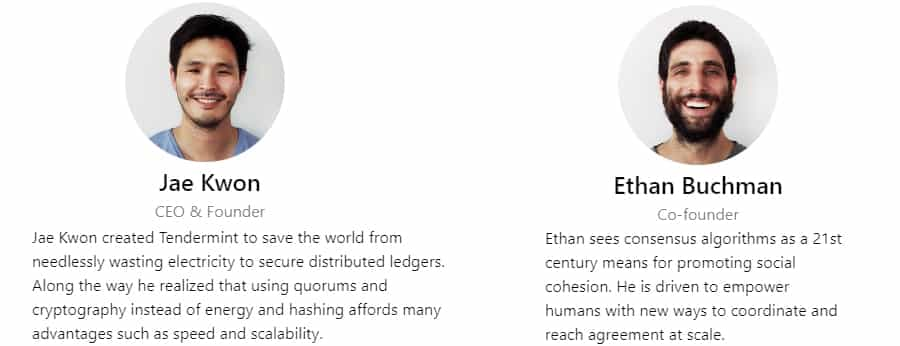
Tendermint Founders developing the Cosmos Network
Finally, there is the IRIS Foundation, which has constitute back up from ICF to create the Cosmos Hub IRISnet, which is meant to facilitate the structure of distributed business applications. All of these entities work together very closely, and information technology tin can be difficult to distinguish between the different organizations and how they contribute to the development of Cosmos.
The squad is also quite active when information technology comes to customs appointment. They run an active official blog where they detail all of the of import development updates. They also take a Twitter account and Telegram Aqueduct. I took a dive into their x,000 member strong Telegram channel the conversation was quite encouraging with more tech focused participants.
The Creation Ecosystem
Cosmos has had no problems attracting partners to its ecosystem. There'south a huge number of projects already developing on top of the Cosmos engineering science and part of its ecosystem. Here'due south just a small-scale group of them:
- The Binance Chain, which is the token emitting platform of the decentralized Binance Launchpad project, is built on the Creation ecosystem. They utilize a forked version of Tendermint and the Creation SDK, as well as Cosmos SDK features such as "bank" which is used for basic token transactions.
- Akash is working to bring serverless computing to Cosmos, functioning equally a peer-to-peer supercloud for serverless computing that will provide developers with an open up, secure, permissionless marketplace for unused compute cycles. They look to reduce the cost of cloud computing resources past 90% in comparing with services such every bit Microsoft Azure, AWS, and Google Cloud.
- e-Money is a European stablecoin issuer. Their stablecoins are backed past fiat currency and are unique in that they carry involvement and are protected by an insolvency fund.
- IOV is creating a protocol between blockchains and wallets that will make it possible to send and receive any cryptocurrency at all from a single accost of value.
- IRISnet is a BPoS blockchain that was built using the Cosmos SDK and will allow interoperability between blockchains to provide a foundation for the adjacent generation of distributed business applications. It launched its mainnet in September 2019.
- Kava is working with the Cosmos network to provide wallets, exchanges and blockchains with the liquidity and interoperability of Interledger engineering science. More than recently they launched their mainnet in November 2019, and the project is at present at the forefront of the blooming DeFi ecosystem.
- Loom began on the Ethereum blockchain and later switched to Creation to take advantage of the Tendermint engineering in its development of highly scalable-games and user-facing dApps. More than recently it has been branching out to tackle DeFi, and usage by governments and ecterprises.
Other projects are aimed at tokenizing the music industry (Playlist), creating a truly decentralized peer-to-peer network (Spotter Network), creating a decentralized democratic content economic system (Lino), edifice a social network to make up one's mind when information is true or not (TruStory), and launching a stablecoin meant for mass adoption (Terra).
At that place'due south a more consummate list of almost 100 projects looking to build on top of the Cosmos Network and Tendermint technology that can be found hither.
The ATOM Token
The Cosmos team held an ICO in April 2017, raising $17.iii million in just 28 minutes every bit they sold 168 million tokens at $0.098 each. The team also withheld 50 million tokens for themselves to fund strategic partnerships and concern development.
The Cantlet token was somewhat unique notwithstanding as the actual tokens were not released until after the master net went live. At that place were some exchanges trading IOU tokens for Atom prior to their release, but the actual token went live on March fourteen, 2019.
Ii days after it reached an all-fourth dimension high of $viii.31 but dropped from that level speedily. It jumped again to nigh $vii on April 22 when investors learned the token had been listed on the Binance Exchange.
The price dropped back again, merely trade volumes have continued increasing steadily. The broad based crypto rally of 2021 took Atom to a new all-time high of $28.49 on April fifteen, 2021, just as of April 24, 2021 the price has dropped back to $18.80.
Register at Binance and Purchase Cantlet Tokens
There is no cap on the number of ATOM that volition be released every bit the squad plans on increasing the number of Atom annually based on an inflationary model.
Cosmos Hub 3
After the March 2019 launch of the mainnet for Cosmos, and prior to the February 2021 launch of IBC, the only other major update from the projection came in December 2019, when they launched Cosmos 3. This update was primarily focused on improving the governance mechanism at Creation.
One of the most of import changes made by Cosmos three is that governance proposals are no longer only a signaling mechanism. Before Creation 3 any proposed changes that were passed by the customs needed to be enacted by developers and released every bit new software that was then run by participating validators. This is also known every bit a hard fork.
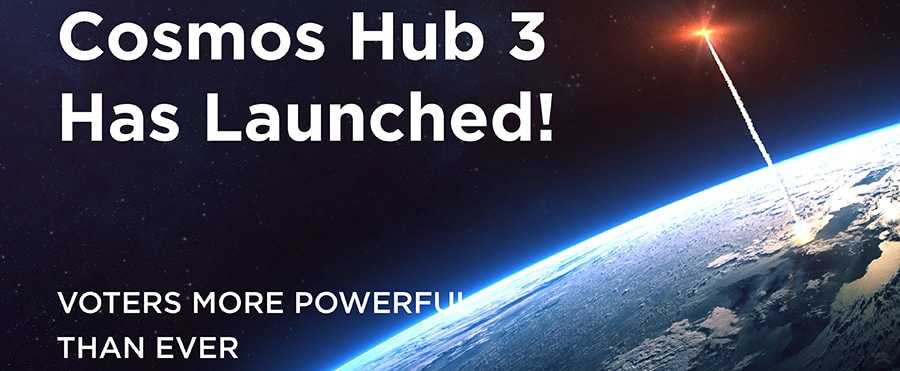
Announcing the Launch of Creation Hub 3. Image via Cosmos Blog
With Cosmos Hub 3 voters are at present able to change how Cosmos works at a fundamental level, and those changes can exist implemented without the demand for a hard fork. Some of the changes that tin can exist made include increasing or decreasing the inflation rate, changing the minimum threshold at which staking influences inflation, the customs tax charge per unit, and many more.
The upgrade to Cosmos Hub three has besides fabricated it possible for proposals to spend government pool funds, which are currently almost 250,000 ATOM worth over $1 meg.
The upgrade to Cosmos Hub three has likewise somewhen made it possible for the community to vote for the launch of IBC and for the cosmos of Gravity DEX.
Gravity DEX
Creation is entering the DeFi infinite by creating the Gravity DEX, which will serve as an Automated Market Maker (AMM) with decentralized liquidity providing and coin swap functions.
The module enables users to create a liquidity pool, brand deposits and withdrawals, and request coin swaps from the liquidity puddle.
Gravity DEX enables decentralized trading between whatsoever two Cosmos tokens — a $90 billion marketplace that includes ATOM, BNB, LUNA, and CRO — or whatsoever of the galaxy of tokens across the Cosmos ecosystem.
Gravity uses the Inter-Blockchain Advice (IBC) protocol to enable swaps and pools of digital assets between whatsoever two blockchains inside the Creation ecosystem or beyond. Gravity likewise achieves superior efficiency compared to other AMMs due to its groundbreaking Equivalent Swap Cost Model.
The Cosmos Hub AMM should have strong philosophy of inclusiveness of users from unlike blockchains considering its prime utility is inter-blockchain communication.
To possess such characteristics, the liquidity module should provide most convenient ways for external users to come in and use the services provided by the Creation Hub.
The liquidity module should non conceptualize specific assets, such as Atom, into the process of user-flow in a forced mode. Information technology is repeatedly proved that unnatural anticipation of native coin at unavoidable parts of procedure resulting in poor user allure.
Development & Roadmap
Of grade, with nearly of these blockchain projects, the proof is in the pudding. In social club to get a sense of just how much piece of work is being done, we need to take a look into the project code commits.
One of the all-time ways to get a sense of this action is through the project's commit activity on their public GitHub. In the instance of Cosmos, you have a number of dissimilar GitHub repos both from the main project to the Tendermint repositories.
I decided to take a sneak peak into these to see the amount of activity that is present. Below are only some of the most active repos in the ecosystem.
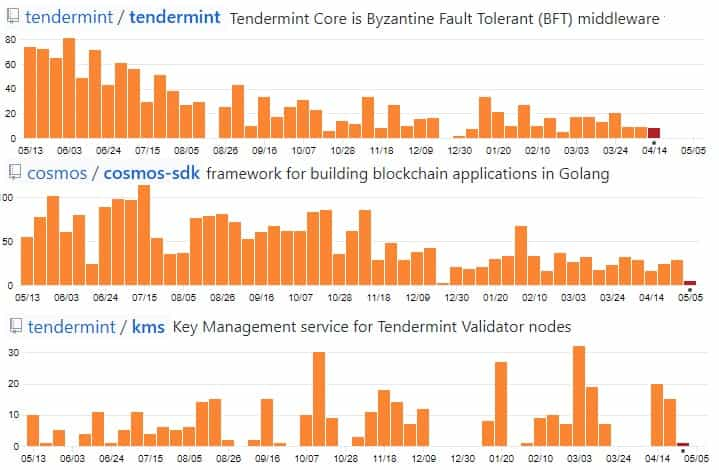
Lawmaking commits over past 12 months for select Repos
This is indeed quite extensive and shows just how much work has been taking identify on the protocol. You should likewise carry in heed that these are but 3 of the top repos. There are over 86 repositories in total!
I take not seen this level of development on many other projects (including those with larger ICOs). This should further reinforce the notion that this is annihilation but a run-of-the-mill ICO and blockchain project.
This voluminous and frenetic coding action is most likely related to their ambitious roadmap. Over the past year the team has been meeting a number of important milestones nigh to a tee.
There are also quite a few upgrade proposals that are lying ahead for the project. These include Hub Back up for the IBC protocol which will let some of the SDK applications to connect to the Hub. You can see the roadmap here.
Decision
The launch of the Cosmos master internet came with huge amounts of excitement among the community equally evidenced by the surge in the toll of the Atom token. The unsolicited improver of the token at Binance and dozens of other exchanges, and the rapid jump of ATOM to the #15 spot in total marketplace cap supports the premise that this is a serious project worthy of post-obit and investing.
Even with the limited updates over the twelvemonth since the mainnet launch, the Cantlet token remains the 35th largest token past market place cap, highlighting the communities conventionalities in the project.
The move to IBC takes Cosmos to its side by side phase of development. With the mainnet launch now complete, and the whitepaper vision finished the team tin can move on to creating boosted value in the concatenation through the utilise of IBC features.
Now that the Galactic Era is reached the development squad will brainstorm work on the decentralized Gravity DEXas well equally bridges for Ethereum and Bitcoin, and various cantankerous-concatenation projects to unlock value from every chain connected to Creation.
Information technology'southward articulate to see that the Tendermint and Cosmos teams are extremely serious about what they are doing. While some were calling the project vaporware fifty-fifty in 2020 for a lack of features listed in the whitepaper, there are literally hundreds of partner projects who believed in the Creation Network and have begun using information technology.
With the launch of IBC, if Cosmos can pull off becoming the internet of blockchains it will inhabit an extremely important and powerful position in the future of blockchain development and technology.
Then far the projection appears to remain on track to do just that, and if the excitement of the community is whatsoever gauge this could exist a project to sentinel closely in coming months and years.
Featured Paradigm via Fotolia
Disclaimer: These are the writer's opinions and should not be considered investment communication. Readers should do their own research.
roadmap hither.

Source: https://www.coinbureau.com/review/cosmos-atom/
0 Response to "How Hard To Get Into Cosmos"
Post a Comment