

How To Register As An Independent Personal Trainer
Are you a fitness professional who loves to train clients, merely feel like you've hit the fe ceiling in your career? If so, then the solution for you might exist to become an online trainer.
You can get started by following these seven steps:
1. Decide what types of clients you want to work with online
two. Create a template with three or four training phases for each blazon of client
3. Compile a video library of the exercises in your online grooming programs
4. Annals for professional software
5. Decide on the best packet and online grooming pricing model for you
six. Create an online personal grooming questionnaire
7. Cull a payment processing service
But before I explain each of them, allow me tell yous how I got here.
When personal grooming forced me into online fitness
I trained clients in-person for eight years.
For most of it, I wasn't happy. I was scared.
With my earning potential maxed, the long hours meant I had no time for friends, family, or a girlfriend.
The catalytic point for me happened during an ice hockey game one nighttime. I got tripped and strained my hamstring.
For most people, a hamstring injury is an inconvenience. For a trainer, it'south a catastrophe.
You can't train clients from your couch, which means you tin can't make a living.
That was when it all changed for me.
I thought, "If a unmarried injury could wipe out 2 weeks' worth of income, training clients isn't a secure way to make a living. Too many things can go wrong."
Online personal training, on the other hand, is more than sustainable.
It's efficient.
Information technology allows you to systematize and scale your business concern, preparation more than clients, in less time, while potentially making more money.
So allow's talk about how to get started as an online personal trainer.
—
Step 1: Decide what types of clients you desire to work with online
All the time I hear trainers say,
"There'southward so many online trainers, why would someone want to work with me?"
Easy. Because you're not those other trainers.
Yous're you.
That gives you lot an advantage over every other trainer out there—even "fitness influencers" and "InstaTrainers" with thousands of online followers.
The big secret to selling online training is to be the right person for a few people.
All it takes is 30 clients paying yous $200 a calendar month to brand $72,000 a year.
Y'all don't need ten,000+ Instagram followers or a massive marketing budget.
What you need is to find your 1 Percent Uniqueness Factor—a niche where you have a articulate advantage.
This is different from the same old "find your niche" advice you've seen before. Information technology's deeper, and much, much more powerful.
At the Online Trainer University, nosotros teach a proven iii-part organization that tin can help any fettle or nutrition pro find their 1 Percentage Uniqueness Factor. Unremarkably, you'd accept to enroll in OTA to learn about it. But I'll share it with you lot here:
STEP one: Place YOUR PARENT Market
Everything we do in the fitness industry can exist categorized into 4 markets. Start by picking the one yous align with best.
STEP 2: Get DEEPER
Next you'll option your submarket. Some examples:
STEP 3: Detect YOUR one% UNIQUENESS Gene
Time to begin!
Each submarket has thousands of potential niches.
When deciding which is correct for yous, recollect about not just your professional person skillset, but also your personal experiences, exterior interests, and whatever else makes y'all you lot.
For instance, here are some niches within the pre- and postnatal category:
- Young mothers
- Older mothers
- C-department
- Diastasis recti
- Mothers with multiple kids
- Military wives who are mothers
Or you could get a flake crazy and combine them:
- Young mothers who are military wives and have had C-sections.
At presentthat is unique!
Don't worry near getting too narrow. Yep, yous'll be cut off some potential clients. Merely those who fit your market will see you lot as the obvious choice.
Think near it this way: If you lot needed surgery for a hernia, would you prefer a general surgeon or a hernia specialist?
Which brings me to . . .
The secret to condign a successful online personal trainer in 2 simple sentences:
"Try to attract everyone, and you'll concenter no one. Try to attract a few people, and anybody will see y'all every bit the expert."
Once you lot find your niche, marketing becomes piece of cake.
In this instance, you'd network in war machine spouse groups. You'd produce content on how to get back to existence active after a C-section. Y'all'd start your own community for armed forces moms.
Translation: More focus. Better results. Less endeavour.
No more than endless (and directionless) content production.
No more wasting fourth dimension and energy.
All your efforts moving forward will be laser-focused and produce results.
And the best part? Once you go your first handful of clients (which you will, fast), you simply take to do a neat job grooming them. That's when the referrals (both in and outside your niche) will roll in.
Remember what I said earlier: To brand $72,000 this twelvemonth, all you need is 30 clients paying you $200 a month.
What practice you think is the all-time way to get and keep thirty paying clients? Will another 2,000 followers on Instagram make whatsoever difference?
—
Pace 2: Create a template with three or four preparation phases for each type of customer
You may call back templated workouts are a disservice to your clients. Merely if you do them correctly, the contrary is true.
The reality is, almost clients fit pretty well into categories.
In whatsoever setting, the conditioning yous write for a 40-year-old human who wants to lose belly fatty will be pretty like to the final i you wrote for that type of client.
A template doesn't mean you won't individualize it. You'll adjust it for each client based on your onboarding procedure and initial assessment.
And then yous'll go along to change it over fourth dimension every bit you lot encounter what does or doesn't piece of work for this client, and as you develop a deeper understanding of your customer'southward goals and abilities.
Some parts of the template won't likely change from client to client:
·Programming considerations – Things like sets, reps, rest, and tempo volition likely stay constant.
·Order of movement patterns – Your first exercise may non always be a squat or deadlift, but it'll probably be some sort of multijoint lower-body movement.
·Conditioning split over the week – How many times the customer trains and how the programs are split over the class of the calendar week likely won't change much.
Other parts of the template volition probably change from client to client:
·Specific exercises – While the exercise category will stay the same, the specific practise may modify every bit yous take into account the customer'due south feel, skill level, and previous injuries or limitations.
·Grips or implements – Clients volition have access to different types of equipment, and, as noted, dissimilar abilities and restrictions.
·Specific artful aspirations – Even amid fat-loss clients, you'll observe a lot of variety in how they draw the type of physique they want to achieve. For some information technology might focus on waist size. For some other it may be nigh a more able-bodied appearance, or wider shoulders, or bigger arms.
—
Step 3: Compile a video library of the exercises in your online training programs
Since you're not there to demonstrate exercises for your clients, you lot need videos to prove them how to exercise each movement.
If you don't accept your own—and most trainers don't—you lot should compile a set of links to other trainers' YouTube videos. It's easy to find good examples of the grade you recommend for the nearly well-known exercises.
If yous use online personal training software (see Step 4), you'll beginning out with a ready-fabricated video library. But it's unlikely that any platform will take videos of every exercise in your programme, including all the progressions, regressions, and modifications you like to use. In those cases, you lot'll still demand to shoot and upload your ain videos.
What makes a good do video?
Go along it uncomplicated, following these basic guidelines:
● No sound
● Decent lighting (don't shoot in your basement, in other words)
● At least 2 full reps
● 10 to twenty seconds long
Remember, these aren't tutorials. They're demonstrations. They're for instant reference in the heart of a conditioning. Chances are your customer will be listening to her own music, and doesn't desire to shut it off to listen to y'all talk virtually the do. She just wants to see how to practice it.
Here'due south a skilful case of a video sit-in. Detect how unproblematic it is:
The video above is from Online Trainer Academy graduate John Kempf. For a skilful case of how to compile your ain video library, and how to organize it on YouTube, bank check out his entire collection here. (I've included a screenshot below too.)
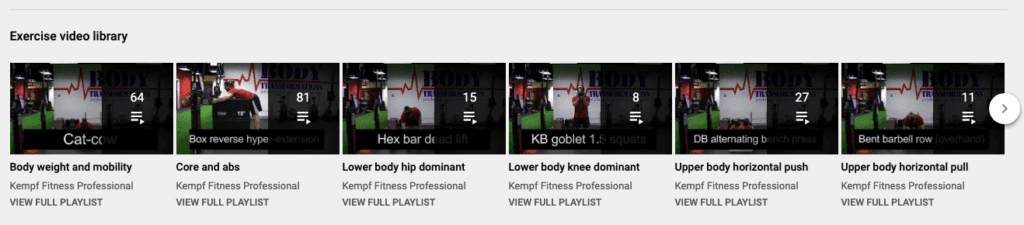
From at that place, y'all'll desire to organize your video collection in a spreadsheet for piece of cake reference.
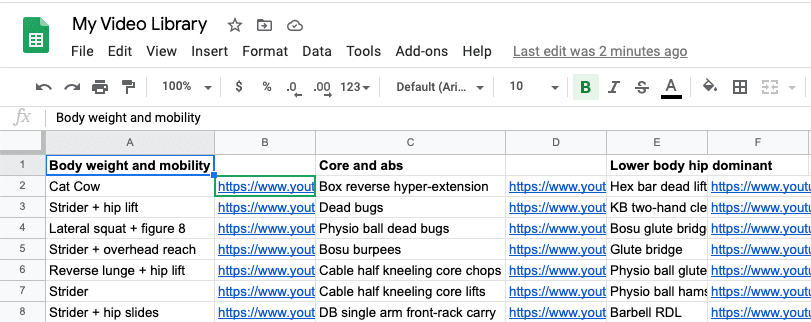
This could exist any combination of videos from the internet, both yours and those from other people. There's nothing wrong passing along a video from somebody else to your clients for reference equally long as it shows the grade you recommend and you don't pretend it'south your ain.
A simple spreadsheet organized by movement pattern works well. Here's an example of how to set up it up:
—
Footstep 4: Register for professional software
I'g a big laic in making coin before spending information technology.
Because of that, I adult free online preparation software for you to apply called QuickCoach.Fit
 Software helps you lot be professional person even with your showtime few clients. Simply you should never pay for software earlier you're making money.
QuickCoach is 100% gratuitous with unlimited clients and workouts. It's a uncomplicated and professional solution tailor-fabricated for coaches with 30 clients or fewer.
You can lookout a demo hither:
–> Click here to register for your costless QuickCoach.Fit account
Step 5: Decide on the best package and online preparation pricing model for yous
As with personal preparation software, there's no "best" online preparation business model. Your goal is to find the correct one for y'all, the one that plays to your strengths without exposing your weaknesses.
In this section I'll share the four most common models, the pros and cons of each, and the nigh common toll range for online training.
1-on-1 (one to a few)
One trainer works with five to thirty clients.
Price range
$100 to $500 a month.
Pros
- Realistic and stable.
- Doesn't crave a large change in service or marketing from in-person training.
- Doesn't require advanced marketing, tech savvy, paid advertising, software, or a website.
Cons
- Slower to start.
- Lacks scalability.
Verdict:
The 1-on-1 model is where most online trainers should start but few will end up.
This is the model we teach in the Online Trainer Academy Level 1.
High-ticket transformation programs
1 trainer works with a minor to medium number of flush clients, all of whom want to attain a specific, measurable result (lower weight, smaller dress size, bigger arms or shoulders) in a defined time period.
Price range
$1,000 to $v,000 for viii to 12 weeks.
Pros
- Can be extremely profitable.
- Allows yous to commit more than of your time to each private client.
- Marketing is more than seamless when you sell a specific result vs. open-ended coaching.
Cons
- Long and complex sales and conversion procedure; most sales require content, paid ads, and at to the lowest degree two phone calls per client.
- Requires well-developed sales skills.
- Uncertain and potentially fragile income stream; losing a single client tin can rock your lesser line, and information technology can take a long time to replace them.
Verdict
A high-ticket transformation programme works well for seasoned online trainers who're willing to invest substantial time and resources into creating content, developing sales skills, and investing in paid advertising.
This is the model nosotros teach in the Online Trainer Academy Level 2, which is just available to coaches who already make at least $1,000 a month online.
Hybrid online training
The hybrid model leverages engineering science to combine in-person training with online coaching.
Price range
$50 to $200 a month, plus whatsoever you charge for each in-person session.
Pros
- Tin be a not bad transition from in-person to online coaching because y'all develop two stable revenue streams without depending on either for 100 percent of your income.
- Gives each client a more flexible and cost-constructive grooming pick.
Cons
- You're notwithstanding limited by location.
- Tin can exist hard to get some of your in-person clients to buy into the idea; some just won't see the benefits the new model offers.
Verdict
The hybrid model is great for gym-based trainers who don't want to stop working with clients in person, or who want to switch to online coaching only need a way to maintain their income while making the transition.
We teach the hybrid online training model in the Online Trainer Academy Level ane.
Depression-terminate membership (one to many)
One trainer works simultaneously with 50-plus clients who pay lower fees, usually through a membership platform.
Price
$10 to $50 a month.
Pros
- Extremely scalable (if you can make it work).
Cons
- It's very hard to differentiate yourself from the competition at depression price points.
- Lots of customers mean lots of headaches.
- When factoring in lifetime customer value and customer acquisition costs, it'due south extremely hard to make it work.
Verdict
Theonly case where I recommend this model is if the trainer has a platform with a huge organic post-obit, generating thousands of costless leads.
We don't teach this model in any of our programs because we've merely seen it work for a scattering of outliers who already have massive audiences for their products or content.
—
Pace half-dozen: Create an online personal training application
No matter how you generate leads for your online training business organization (content, social media, referral, advert), i thing is certain:
The only reason you generate traffic and market online is to attract a prospect and persuade them to enter their information into your system so you can follow upward.
The improve and more efficiently yous practise this, the more than successful you'll get.
It'due south that simple.
An awarding form is actually simple. Think of it equally a virtual handshake. The goal is to gather info and build rapport.
It'southward gratuitous to fix with Google forms.
Here's what to include:
- The nuts: Proper name, age, gender, email, phone number.
- Health information: Injury history, illnesses, or limitations.
- Grooming history: What have they done in the past?
- Rapport builders: Inquire a question or two to build rapport (favorite flick, superhero, etc.).
- Script-flipping questions: Why does this person want to train with you specifically?
- Prequalifying questions: Ask a yes-or-no question to determine if they're willing to invest money on their health and fettle. Make the questions specific to the price range of your services ($200 to $400 a month, for example).
Recall of the application form as your beginning meeting with a client, as I explain in this five-minute video from the Online Trainer Academy:
Two good examples from OTA graduates:
· Hither's a class Lee Kingham of Phoenix Nutrition & Fitness NI has embedded on his site.
· Here's a longer, more personality-driven Google class (information technology asks if yous're willing to "swallow blended chicken and unicorn blood" to accomplish your goals) from Tyler DiRienzo.
—
Step vii: Cull an online preparation payment processing service
This pace is simple.
Use PayPal if you're comfy with it.
It's easy to implement, fees are reasonable, and you can deposit money straight into your bank account for free.
If you're in the Us, Venmo is an choice with lower fees. Just continue in mind that you can't apply it internationally.
On the subject field of credit card processing fees:
Information technology'southward a cost of doing business concern. Worried almost the 3 percent fee? Charge 5 percent more.

How To Register As An Independent Personal Trainer,
Source: https://www.theptdc.com/articles/how-to-be-an-online-personal-trainer
Posted by: flowersplent1953.blogspot.com
0 Response to "How To Register As An Independent Personal Trainer"
Post a Comment