

What Is The Demographics Of Registered Texas Voters
The Changing Racial and Ethnic Composition of the U.Due south. Electorate
The upcoming 2020 presidential election has drawn renewed attention to how demographic shifts across the United States take inverse the composition of the electorate.
For this data essay, we analyzed national and state-level shifts in the racial and ethnic makeup of the United States electorate between 2000 and 2018, with a focus on key battleground states in the upcoming 2020 election. The analysis is primarily based on data from the U.S. Census Bureau's American Customs Survey and the 2000 U.South. decennial census provided through Integrated Public Use Microdata Serial (IPUMS) from the University of Minnesota.
Run into here to read the data essay's methodology for further details on our information sources.
Eligible voters refer to persons ages xviii and older who are U.S. citizens. They brand up thevoting-eligible population orelectorate. The termseligible voters,voting eligible,the electorate andvoters are used interchangeably in this report.
Registered voters are eligible voters who take completed all the documentations necessary to vote in an upcoming election.
Voter turnout refers to the number of people who say they voted in a given ballot.
Voter turnout rate refers to the share of eligible voters who say they voted in a given election.
Naturalized citizensare lawful permanent residents who accept fulfilled the length of stay and other requirements to become U.South. citizens and who accept taken the oath of citizenship.
The termsLatino andHispanic are used interchangeably in this report. Hispanics are of whatsoever race.
References toAsians,Blacks andWhites are unmarried-race and refer to the non-Hispanic components of those populations.
Battlefield states include Arizona, Florida, Michigan, North Carolina, Pennsylvania and Wisconsin. These states were identified by Pew Research Center using ratings from a variety of sources, see the methodology for more than details.
In all 50 states, the share of non-Hispanic White eligible voters declined between 2000 and 2018, with 10 states experiencing double-digit drops in the share of White eligible voters. During that same period, Hispanic voters have come up to make upwardly increasingly larger shares of the electorate in every state. These gains are particularly big in the Southwestern U.S., where states like Nevada, California and Texas have seen rapid growth in the Hispanic share of the electorate over an 18-year period.1
These trends are also peculiarly notable in battlefield states – such as Florida and Arizona – that are likely to be crucial in deciding the 2020 election.2 In Florida, 2-in-ten eligible voters in 2018 were Hispanic, about double the share in 2000. And in the emerging battlefield state of Arizona, Hispanic adults fabricated upwards about ane-quarter (24%) of all eligible voters in 2018, upwards 8 percentage points since 2000.
To be sure, the demographic limerick of an area does not tell the whole story. Patterns in voter registration and voter turnout vary widely by race and ethnicity, with White adults historically more likely to be registered to vote and to turn out to vote than other racial and ethnic groups. Additionally, every presidential election brings its own unique prepare of circumstances, from the personal characteristics of the candidates, to the economic system, to historic events such equally a global pandemic. Still, understanding the changing racial and indigenous composition in key states helps to provide clues for how political winds may shift over time.
Black, Hispanic and Asian registered voters historically lean Autonomous
The ways in which these demographic shifts might shape electoral outcomes are closely linked to the distinct partisan preferences of different racial and indigenous groups. Pew Research Center survey data spanning more than two decades shows that the Democratic Party maintains a wide and long-standing advantage amid Black, Hispanic and Asian American registered voters.iii Among White voters, the partisan residue has been generally stable over the past decade, with the Republican Party belongings a slight advantage.
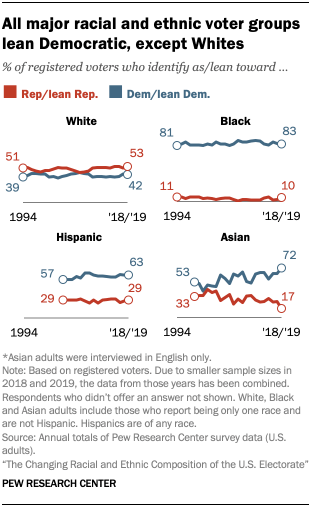
National go out polling information tells a like story to partisan identification, with White voters showing a slight and fairly consistent preference toward Republican candidates in presidential elections over the terminal 40 years, while Blackness voters have solidly supported the Autonomous contenders. Hispanic voters take also historically been more likely to support Democrats than Republican candidates, though their support has not been every bit consistent every bit that of Black voters.4
These racial and ethnic groups are by no means monolithic. In that location is a rich diversity of views and experiences within these groups, sometimes varying based on country of origin. For example, Pew Research Center's 2018 National Survey of Latinos constitute that Hispanic eligible voters of Puerto Rican and/or Mexican descent – regardless of voter registration status – were more than likely than those of Cuban descent to identify as Democrats or lean toward the Democratic Party (65% of Puerto Rican Americans and 59% of Mexican Americans vs. 37% of Cuban Americans identified every bit Democrats). A majority of Cuban eligible voters identified as or leaned toward the Republican Party (57%).
Amidst Asian American registered voters, there are also some differences in party identification by origin group. For instance, Vietnamese Americans are more probable than Asians overall to identify equally Republican, while the opposite is truthful amidst Indian Americans, who tend to lean more Democratic.
Given these differences within racial and indigenous groups, the relative share of different origin groups within a specific state can touch on the partisan leanings of that country'due south electorate. For example, in Florida, Republican-leaning Cubans had historically been the largest Hispanic origin group. Nevertheless, over the by decade, the more than Democratic-leaning Puerto Ricans have been the state'due south fastest-growing Hispanic-origin group, and they now rival Cubans in size. At the aforementioned time, in states similar California and Nevada, Mexican Americans, who tend to lean Democratic, are the dominant Hispanic origin group.
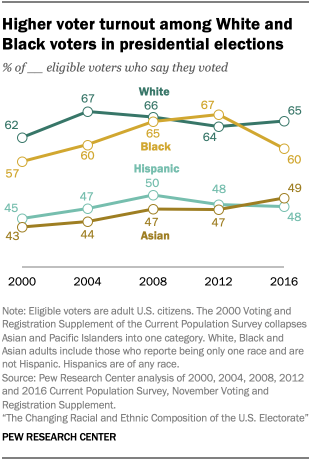
Partisan alignment does not tell the whole story when it comes to voting patterns. Voter turnout rates – or the share of U.S. citizens ages xviii and older who cast a ballot – also vary widely across racial and ethnic groups. White adults historically have had the highest charge per unit of voter turnout: Virtually two-thirds of eligible White adults (65%) voted in the 2016 election. Black adults have also historically had relatively high rates of voter turnout, though typically slightly lower than White adults. At that place was an exception to this pattern in 2008 and 2012, when Black voter turnout matched or exceeded that of Whites. By contrast, Asian and Hispanic adults have had historically lower voter turnout rates, with nearly half reporting that they voted in 2016.
White and Black adults are also more probable than Hispanic and Asian adults to say that they are registered to vote.
Non-White eligible voters accounted for more three-quarters of total U.South. electorate growth since 2000
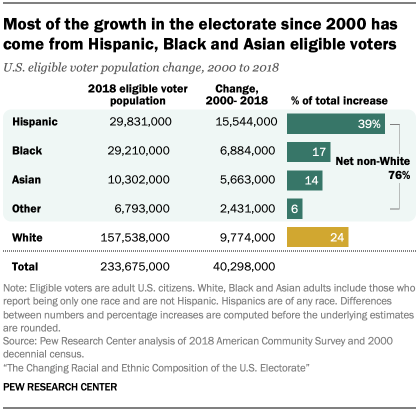
The non-White voting population has played a large role in driving growth in the nation's electorate. From 2000 to 2018, the nation's eligible voter population grew from 193.4 million to 233.7 million – an increase of twoscore.3 one thousand thousand. Voters who are Hispanic, Blackness, Asian or some other race or ethnicity accounted for more than than three-quarters (76%) of this growth.
The substantial percentage point increment of voters who are non White every bit a share of the land'due south overall electorate was largely driven past second-generation Americans – the U.South.-born children of immigrants – coming of age, likewise equally immigrants naturalizing and becoming eligible to vote. The increase has been steady over the by 18 years – from 2000 to 2010, their share rose past 4 percentage points (from 24% to 28%), while from 2010 to 2018, their share farther grew past 5 points (up from 28% to 33%).
Hispanic eligible voters were notably the largest contributors to the electorate'southward rise. They alone accounted for 39% of the overall increase of the nation'due south eligible voting population. Hispanic voters fabricated upwardly 13% of the land's overall electorate in 2018 – almost doubling from 7% in 2000. The population's share grew steadily since 2000, with like percentage bespeak growth observed betwixt 2000 and 2010 (3 points) and 2010 and 2018 (3 points).
The Hispanic electorate's growth primarily stemmed from their U.Southward.-built-in population coming of age. The 12.iv million Hispanics who turned 18 between 2000 and 2018 accounted for 80% of the growth among the population'due south eligible voters during those years. The grouping's sustained growth over the past two decades will make Hispanics the projected largest minority grouping among U.Southward. eligible voters in 2020 for the first time in a presidential election.
Asian eligible voters also saw a significant ascension in their numbers, increasing from 4.6 million in 2000 to 10.3 one thousand thousand in 2018. And like to Hispanics, their well-nigh ii-decade growth has been relatively consistent. The population's share in the electorate grew at similar rates from 2000 to 2010 and from 2010 to 2018 (1 signal each). In 2018, Asian eligible voters made up four% of the nation'south electorate (up from 2% in 2000), the smallest share out of all major racial and ethnic groups. Naturalized immigrants – a group that makes up two-thirds of the Asian American electorate – are the principal commuter of the Asian electorate'due south growth. From 2000 to 2018, the number of naturalized Asian immigrant voters more than doubled – from three.3 1000000 to 6.9 million – and their growth solitary accounted for 64% of the overall growth in the Asian electorate.
Despite notable growth in the not-White eligible voter population, non-Hispanic White voters still made up the large bulk (67%) of the U.South. electorate in 2018. However, they saw the smallest growth charge per unit out of all racial ethnic groups from 2000 to 2018, causing their share to shrink past nigh x percent points.
Shares of non-Hispanic White eligible voters have declined in all 50 states
The overall refuse in the shares of the not-Hispanic White eligible voter population can be observed across all states. (There hasn't been a decline in the District of Columbia.) While this tendency is not new, it is playing out to varying degrees beyond the state, with some states experiencing particularly significant shifts in the racial and ethnic composition of their electorate.
In total between 2000 and 2018, 10 states saw a 10 percentage point or greater refuse in the share of White eligible voters. In Nevada, the White share of the electorate vicious eighteen percentage points over almost two decades, the largest drop among all l states. The refuse in the White share of the electorate in Nevada has been fairly steady, with a comparable percentage bespeak decline observed between 2000 and 2010 (10 points) and 2010 and 2018 (viii points). California has experienced a similarly precipitous refuse in the White share of the electorate, dropping 15 per centum points since 2000. This has resulted in California changing from a majority White electorate in 2000 to a land where White voters were a minority share of the electorate in 2018 (60% in 2000 to 45% in 2018), though they still are the largest racial or ethnic grouping in the electorate.
Even with declines in all 50 states, White eligible voters still brand upwardly the bulk of well-nigh states' electorates. In 47 states, over half of eligible voters are White. The only exceptions are California, New Mexico and Hawaii, where White voters account for 45%, 43% and 25% of each respective state's electorate.
As reflected on the national level, Hispanic eligible voters have been the principal drivers of the racial and indigenous diversification of virtually states' electorates. In 39 states between 2000 and 2018, Hispanic eligible voters saw the largest per centum betoken increase compared with any other racial or indigenous group. In iii boosted states – Alaska, Kentucky and Ohio – Hispanic voters were tied with some other racial grouping for the highest increment. Five states that observed the largest growth in Hispanic shares in their electorates were California (11 percentage points), Nevada (10 points), Florida (ix points), Arizona (8 points) and Texas (eight points).
The number of Blackness eligible voters nationwide grew only slightly in the past 18 years. However, Black voters saw the largest percentage point increase out of whatever other racial and ethnic group in iii states in the Southeast: Georgia (5 points), Delaware (4 points) and Mississippi (4 points).
Equally for Asian eligible voters, they saw robust growth in California (5 percentage points), Nevada and New Jersey (four points each) betwixt 2000 and 2018. However, their share increases paled in comparison to the Hispanic electorate'south growth in those states. Overall, Asians saw their shares increase in the electorates of every state except Hawaii, where their share dropped by four percentage points. All the same, Hawaii has the highest percentage of Asians in its electorate – 38% of all eligible voters in the state are Asian.
Racial and ethnic alter amid eligible voters in battleground states
As the 2020 presidential election draws near, these demographic shifts are particularly notable in some central battleground states, where changes in the limerick of the electorate could have an touch on electoral outcomes.five
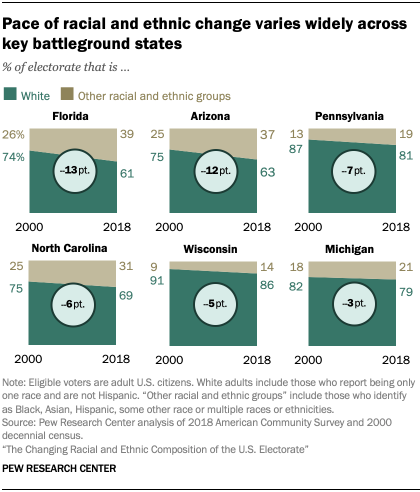
Nationally, Florida and Arizona saw the third- and fourth-largest declines in the shares of non-Hispanic White eligible voters. The White shares of the electorate in those states each stood at almost six-in-ten in 2018, downward from nearly three-quarters at the start of the century. Four other battlefield states – Pennsylvania, North Carolina, Wisconsin and Michigan – besides saw declines in the share of White eligible voters betwixt 2000 and 2018, though to a lesser extent.
In Florida, a state that has been pivotal to every U.Due south. presidential victory in the last twenty years, the White share of the electorate has fallen xiii per centum points since 2000. At the same time, the Hispanic share of the electorate has gone up 9 points, rising from 11% of eligible Florida voters in 2000 to xx% in 2018. During this same catamenia, the Black share of the electorate in Florida has increased ii percentage points and the Asian share has increased by i point.
Arizona, largely seen as an emerging battleground state, has seen substantial change to the racial and ethnic composition of its electorate. Hispanic adults now make upward virtually ane-quarter of all eligible voters (24%), an 8-point increase since 2000.
Several battleground states have seen smaller – though nonetheless potentially meaningful – changes to the demographic composition of the electorate. In Pennsylvania, the White share of the electorate roughshod 7 percentage points while the Hispanic share of the electorate rose iii points from 2000 to 2018. And in Due north Carolina, a state that voted for Donald Trump in 2016 and previously went for Barack Obama, George W. Bush and Beak Clinton, the White share of the electorate vicious from 75% in 2000 to 69% in 2018. During the aforementioned time menstruum, the Hispanic share of the electorate rose to iv% (up 3 points since 2000) and the Black share of the electorate rose to 22% (upward one point since 2000).
Demographic changes could proceed to reshape the electoral mural in future elections. While Texas is not currently considered a battleground country, demographic shifts take led some to wonder if the state could become more competitive politically downwards the route. In 2018, iii-in-10 eligible voters in Texas were Hispanic – that'south up 8 per centum points since 2000. During that same fourth dimension, the share of White eligible voters in Texas vicious 12 points, from 62% in 2000 to a bare majority (51%) in 2018.

Source: https://www.pewresearch.org/2020/09/23/the-changing-racial-and-ethnic-composition-of-the-u-s-electorate/
Posted by: flowersplent1953.blogspot.com
0 Response to "What Is The Demographics Of Registered Texas Voters"
Post a Comment